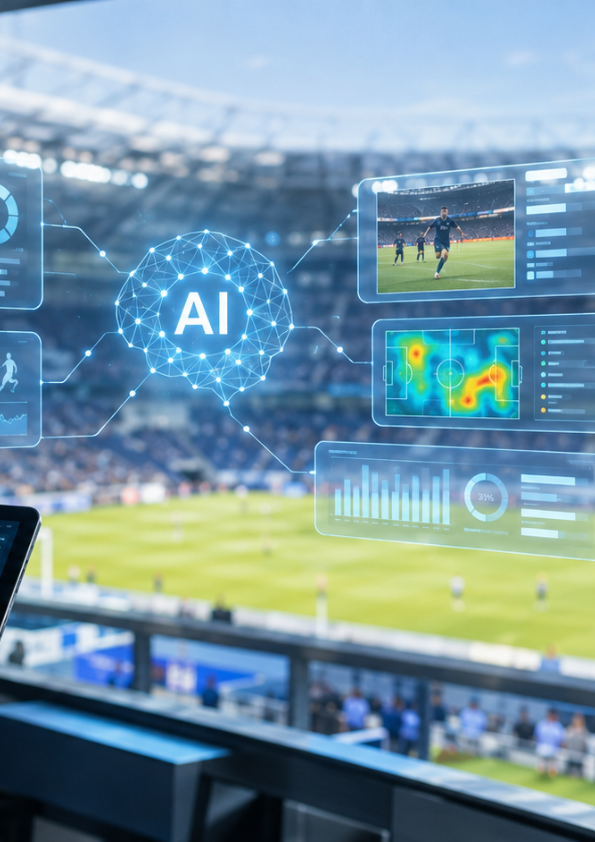

How are sports leagues across Germany, Austria, and Switzerland using tech ecosystems to transform performance, media operations, and fan experiences?
Tech Ecosystems by League: Football Leagues
Bundesliga
The DFL operates a centralised innovation model for the Bundesliga and its member clubs driven by in-house initiatives and wide-reaching tech partnerships.
In order to maintain control over its data, the DFL co-founded Sportec Solutions with Deltatre. The business operates the Bundesliga Data Hub which uses up to 20 cameras per stadium to capture over three million positional data points per match. This data is processed in real-time using an event-driven, cloud architecture, feeding tactical analytics, live statistics, and betting platforms.
The digital backbone of the Bundesliga is their partnership with Amazon Web Services (AWS), with the tech giant applying their cloud and AI technologies to power everything from personalised fan experiences to media production and data services. A good example of this is “Bundesliga Match Facts” which uses AWS AI to analyse the complex tracking data from the Data Hub and translate this into metrics like Shot Efficiency and Goal Probability that are used to enhance broadcast storytelling.
The Bundesliga are also pioneering generative AI solutions through their AWS partnership including automated, multi-language commentary and vertical, mobile-first broadcast production.
Away from the pitch, the league uses its partnership with ServiceNow to optimise operations through AI-powered workflow automation, seamlessly connecting clubs, sponsors, and media partners
At a club level, investment in state-of-the-art stadiums for the 2006 FIFA World Cup has provided the ideal platform for the league to pilot initiatives such as 5G, augmented reality, and smart IoT infrastructure.
The strength of the league’s commitment to innovation can be seen in initiatives like the Bundesliga Hackathon which invites developers, startups and tech ecosystems partners to collaborate to build new applications using official match data and APIs and individual clubs like Eintracht Frankfurt have their own dedicated innovation units.
The Austrian Bundesliga
Like their German name’s sake, the Austrian Football Bundesliga also operates a centralised digital strategy focusing on data analytics, broadcast production, and fan engagement, giving them a tech infrastructure that allows them to punch above their middle-weight league status.
Their strategy is built around a long-standing partnership with Stats Perform. The agreement allows clubs to leverage their SportVU optical tracking and Edge Viewer video platforms, providing deep event data and AI-assisted tactical tools that significantly enhance sports science and recruitment. The league also established a partnership with Stats Bomb in 2022 that gives them access to their advanced data and IQ analysis platform.
Broadcast production will also be centralised from 2026/27 season through their partnership with Uppercut Media which will allow them to introduce cost-efficient, remote production workflows from a centralised hub in Vienna. Fans will also continue to enjoy data driven infographics as part of Sky Austria’s coverage, powered by Stats Perform.
To maximise the value of its digital assets, the league relies on a long-term agreement with Sportradar, which globally distributes live feeds and betting market data while managing match integrity monitoring.
Swiss Super League
The technology strategy of Swiss football’s topflight is also built around a comprehensive partnership with Stats Perform. The agreement creates a robust data infrastructure that allows the Swiss Super League (SFL) to support teams with tactical and recruitment analysis, drive commercial revenues through sportsbook integrations and use Stats Perform’s PressBox Graphics tool to automatically generate real-time data visualisations for broadcasters, social media and digital platforms.
Through a partnership with digital asset management specialists, ScorePlay, the SFL uses AI-assisted workflow automation to enable content teams, clubs, and media partners to instantly clip and distribute broadcast-quality footage across domestic TV networks, international OTT streaming platforms, and social media channels.
At an individual club level Swiss football terms partner with performance tech providers such as Wyscout and Hudl, to optimise player workloads and tactical preparation while also building their own tech stacks around fan engagement delivering features such as digital ticketing and interactive fan apps around increasingly smart stadiums.
Tech Ecosystems by League: Handball Leagues
The Handball-Bundesliga
Germany’s Handball-Bundesliga (HBL) has sought to transform its digital ecosystem through a series of strategic partnerships. Under their deal with the Schwarz Group, Schwarz Digits will provide cloud services via their STACKIT solution and cybersecurity via XM Cyber.
The league relies on a deal with Sportradar for its core competition management platform, seamlessly integrating match data, administration and media workflows into a single operational environment. Sportradar also collects and globally distributes the league’s official match data, supplying real-time statistics to sportsbooks and media in over 100 countries, while actively protecting competition integrity through its real-time Universal Fraud Detection System.
The HBL’s match data is created through their long-standing agreement with Kinexon Sport – perhaps the defining feature of the league’s technology strategy. Through a mix of wearable player sensors, smart chips embedded in match balls and arena receiver networks, Kinexon captures exact speed, acceleration, and positional data. This intelligence is crucial for coaches monitoring player load and injury risks, and it also used to drive dynamic broadcast and in-stadia graphics.
In 2023/24, the HBL moved to a direct-to-consumer (D2C) streaming model, partnering with Dyn to run their OTT streaming platform, HBL TV. Under this agreement, the league leverages Dyn’s AI-driven media workflows to power a central content desk, enabling automated highlight production and the management of a fully digitised, cloud-based media archive.
To deepen fan engagement, HBL partnered with PASS Consulting Group to develop mobile apps and the START7 fantasy handball game. It also created the Handball Performance Index (HPI) in partnership with Deutsche Kreditbank which aggregates real-time match stats and Kinexon tracking data to create player scores which determine MVP, Player of the Month, and power START7.
Handball Liga Austria Meisterliga
The Handball Liga Austria (HLA) and the Austrian Handball Federation (ÖHB) run Austria’s top tier of handball, operating a streamlined digital ecosystem based around strategic technology partnerships. The foundational element is their official data partnership with Sportradar which allows the league to leverage Sportradar’s Live Sports Centre platform to collect and distribute real-time data, powering broadcast graphics and tactical analysis, but also fuelling betting markets and digital fan engagement.
To maximise reach, the HLA employs a hybrid broadcast model combining traditional television coverage via domestic broadcasters, with modern digital delivery via ÖHB LIVE, an OTT streaming platform developed with Solidsport. This platform empowers clubs to manage their own streaming channels, offer video-on-demand replays, and implement digital ticketing.
To deliver operational efficiency, the HLA partners with NuLiga, a digital competition management software that automates scheduling and seamlessly integrates live scores directly into broadcast streams.
In terms of performance tech, Sideline Sports are deeply embedded within Austrain Handball, providing specialist video analysis tools for the National Team, along with a number of HLA Meisterliga clubs directly.
Quickline Handball League (QHL)
Switzerland’s Quickline Handball League has constructed an advanced technology infrastructure based on partnerships, AI and cloud-based platforms that is primarily focused on maximising reach and efficiency.
A cornerstone of this infrastructure is the league’s partnership with RED.Sport Network, which sees them manage both production via fixed, automated cameras in stadiums and distribution through their RED+ platform that serves as the primary streaming hub for QHL. This arrangement minimises broadcast costs whilst guaranteeing coverage distribution.
QHL partners with Magnifi to implement AI-driven content automation, seamlessly processing over 1,000 matches per season, to instantly generate player-specific highlight reels, goal compilations, and social-media-ready clips. Fans can access this content via QHL’s Digital Hub, a dedicated mobile-first platform born out of the RED.Sports Network collaboration, a mobile-first platform that aggregates league news, stats, schedules, and editorial content.
Tech Ecosystems by League: Ice Hockey Leagues
Deutsche Eishockey Liga
The Deutsche Eishockey Liga (DEL) operates a partnerships driven, digital ecosystem focused on enhancing data collection, broadcast quality, tactical analysis, athlete health, and fan engagement.
At the core of the league’s operations is its partnership with the Finnish sports analytics company Wisehockey. Using embedded puck sensors alongside specialized arena positioning technology, this automated tracking system captures real-time player movements and match events. The data is converted into match insights which are used to enhance coaching decision-making, broadcast output and smart arena displays.
Audiences primarily experience this data integration through MagentaSport, an OTT streaming platform, operated by Deutsche Telekom, that serves as the digital broadcast hub for the league. Streaming every DEL match live, MagentaSport pairs high-quality, multi-camera production with real-time statistical overlays generated by the Wisehockey data.
On the performance side, video-analysis software providers like Dartfish work with DEL clubs to review tactics and aid scouting. The league also puts a strong onus on player health and recovery through advanced sports-science integrations. For example, teams have widely adopted PolarCap® technology by PolarCool – a specialized medical cooling device used for the immediate treatment of suspected concussions to mitigate potential long-term head injuries.
ICE Hockey League
The ICE Hockey League (ICEHL), the Central European competition in which Austria’s top clubs compete, has developed a streamlined yet sophisticated technology ecosystem built around real-time analytics, OTT streaming and performance technology.
Like DEL, ICEHL relies on Wisehockey’s data capture and analysis, leveraging their Quuppa BLE (Bluetooth Low Energy) sensors embedded in pucks and player tags in order to track metrics like puck trajectory and speed and player skating velocities. The data streams feed directly into coaching dashboards for tactical adjustments and are used to power broadcast graphics.
For broadcast production and distribution, ICEHL supplements domestic free-to-air deals through a streaming partnership with Sporteurope.TV which acts as the central OTT hub, live-streaming all regular-season and playoff games to an international audience. This infrastructure ensures that high-definition video, match replays, and integrated statistics are accessible across all digital devices.
In terms of performance and athlete wellbeing, Austrian teams, notably EC Red Bull Salzburg, EC-KAC, and the Vienna Capitals, serve as the league’s primary technology drivers. These clubs pilot advanced sports-science tools to monitor player fatigue and workload, alongside sophisticated video-analysis platforms for opposition scouting.
Swiss National League
The Swiss National League (NL) has created a “Smart League” model that seamlessly integrates high-speed data tracking, automated content creation, and centralized broadcasting to serve clubs, athletes, and a growing digital fan base.
From a media perspective, the league’s strategy is anchored by a partnership with Sunrise, operating through its MySports brand. This collaboration utilizes centralized, IP-based remote production to deliver 4K/UHD coverage of every game.
To scale its digital output, the NL works with WSC Sports, an AI-driven platform that automatically analyses live match feeds. Within seconds of a goal or big hit, the system generates real-time highlights and personalized clips tailored for social media, the official NL app, and club-specific channels, significantly increasing streamlining its digital distribution.
On the ice, the NL utilizes a league-wide deployment of Kinexon Sports technology. Ultra-Wideband (UWB) sensors are embedded in both the puck and player jerseys, plus and local positioning anchors installed in every arena, to capture accurate real-time match data.
These data streams feed directly into team’s professional coaching tools such as Dartfish or Catapult Thunder, which overlay Kinexon metrics onto game footage, allowing for data-visualized tactical reviews.
Furthermore, the league and the Swiss Ice Hockey Federation utilize the Force8 (My Ice Hockey) platform. This centralized system manages training schedules, game scouting, and athlete development metrics across the entire Swiss talent pipeline, from youth levels to the professional ranks.
How are sports leagues across the DACH region building and scaling their tech ecosystems to drive innovation?
Download the full whitepaper to explore the strategies shaping the future of sport in the DACH Region.
Prefer a conversation? Schedule an intro call here to explore tailored solutions for your organisation.